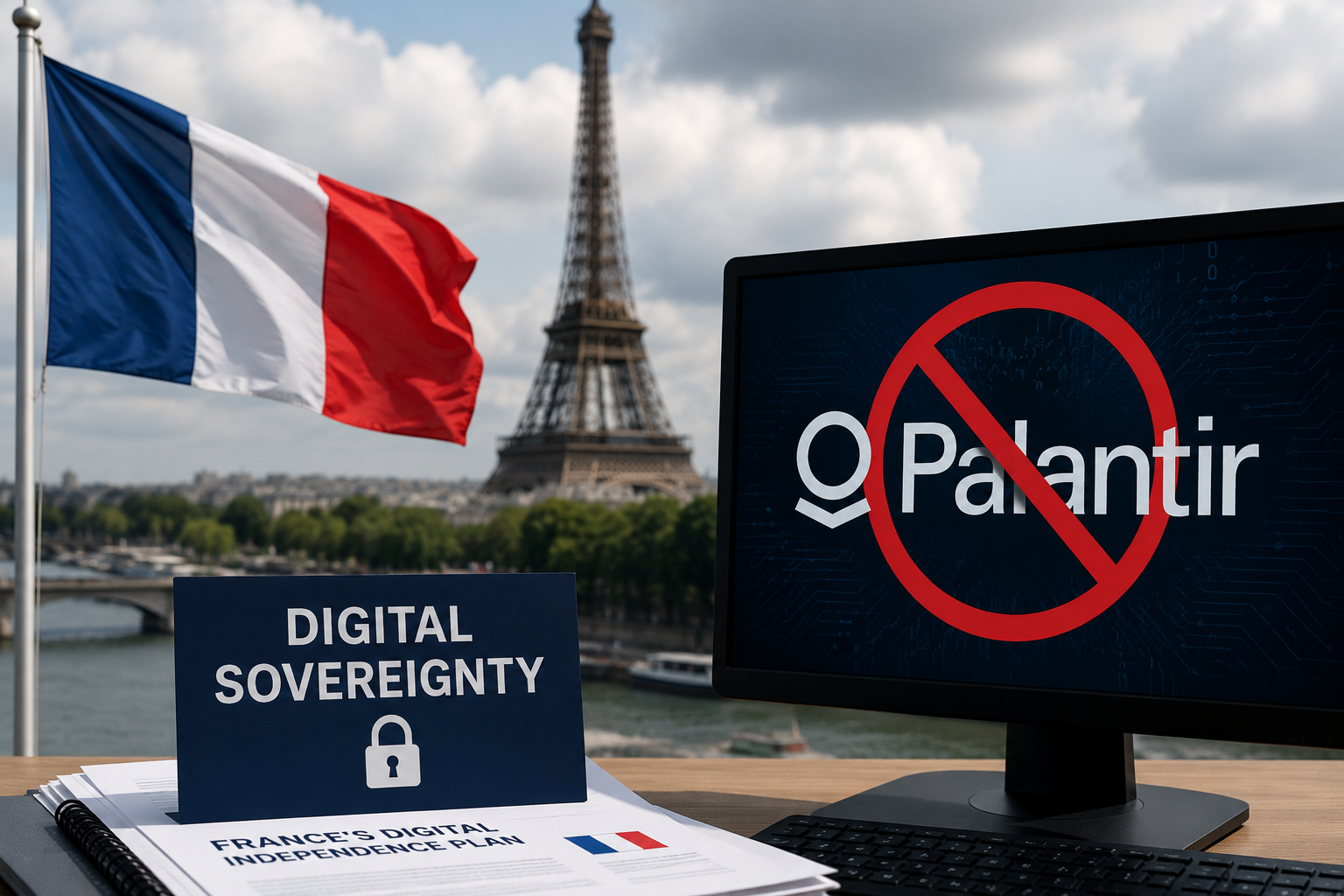
France has announced plans to discontinue the use of software provided by American data analytics company Palantir, marking a significant step in the country's efforts to strengthen technological independence and reduce reliance on foreign digital infrastructure.
The decision affects the General Directorate for Internal Security (DGSI), France's domestic intelligence agency, which has relied on Palantir's advanced data-analysis platform since the aftermath of the 2015 terrorist attacks.
French authorities said the move forms part of a broader strategy aimed at safeguarding national interests and ensuring that critical digital systems remain under domestic control.
Speaking on the development, French Prime Minister Sébastien Lecornu emphasized the importance of reducing what he described as strategic dependencies in key technological sectors.
According to him, countries must avoid situations where access to essential digital services and artificial intelligence tools could be restricted by foreign governments or companies.
The decision follows growing concerns across Europe after recent restrictions imposed by United States authorities on access to certain advanced artificial intelligence models for some foreign users on national security grounds.
French officials reportedly viewed the development as a reminder of the potential risks associated with heavy dependence on foreign technology providers.
Former Prime Minister Gabriel Attal described the changing global landscape as the beginning of an “AI war,” while former Interior Minister Bruno Retailleau warned that nations lacking control over their own digital infrastructure could become vulnerable in the future.
Palantir, a US technology company co-founded by entrepreneur Peter Thiel with early support from the Central Intelligence Agency (CIA), is known for developing software used by governments and organizations to analyze large volumes of data and support decision-making processes.
Despite previously renewing its contract with Palantir after concluding that domestic alternatives had not yet reached the required technical standards, France now appears determined to transition toward homegrown solutions.
French technology company ChapsVision has emerged as the leading candidate to replace Palantir within the country's intelligence and security framework.
The policy shift aligns with President Emmanuel Macron's long-term vision of positioning France as a major artificial intelligence hub within Europe.
The French government has invested heavily in AI research, data centres, digital infrastructure, and local technology firms as part of efforts to strengthen national competitiveness and reduce dependence on both American and Chinese technology giants.
The move also reflects a wider European trend toward technological self-sufficiency.
European Commission President, Ursula von der Leyen, has repeatedly advocated the development of European-owned artificial intelligence systems, cloud infrastructure, and digital ecosystems capable of competing globally.
As part of its digital sovereignty agenda, France is also promoting domestic AI company Mistral AI as a European alternative to major American AI firms and plans to deploy its AI assistant across segments of the public sector.
Analysts believe the decision could influence other European governments to reassess their dependence on foreign technology providers, particularly in sensitive areas involving intelligence, security, and public administration.
The development underscores a growing global debate over technological sovereignty, national security, and control of critical digital infrastructure in the age of artificial intelligence.




💬 Comments 0
Leave a Comment
No comments yet.
Be the first person to comment on this article.